


Several studies in neurophysiology require the comparison between neuronal responses. Victor and Purpura developed a measure of distance between spike trains based on work in molecular biology to compute distances between DNA sequences:
Victor, J. D. & Purpura, K. P. Metric-space Analysis of Spike trains, algorithms and application. Network: Computation and Neural Systems (1997) 8:127-164
We have used this spike metric to quantitatively characterize the variability of the responses to random amplitude modulations in the electric field in P-receptor afferents of Eigenmannia.
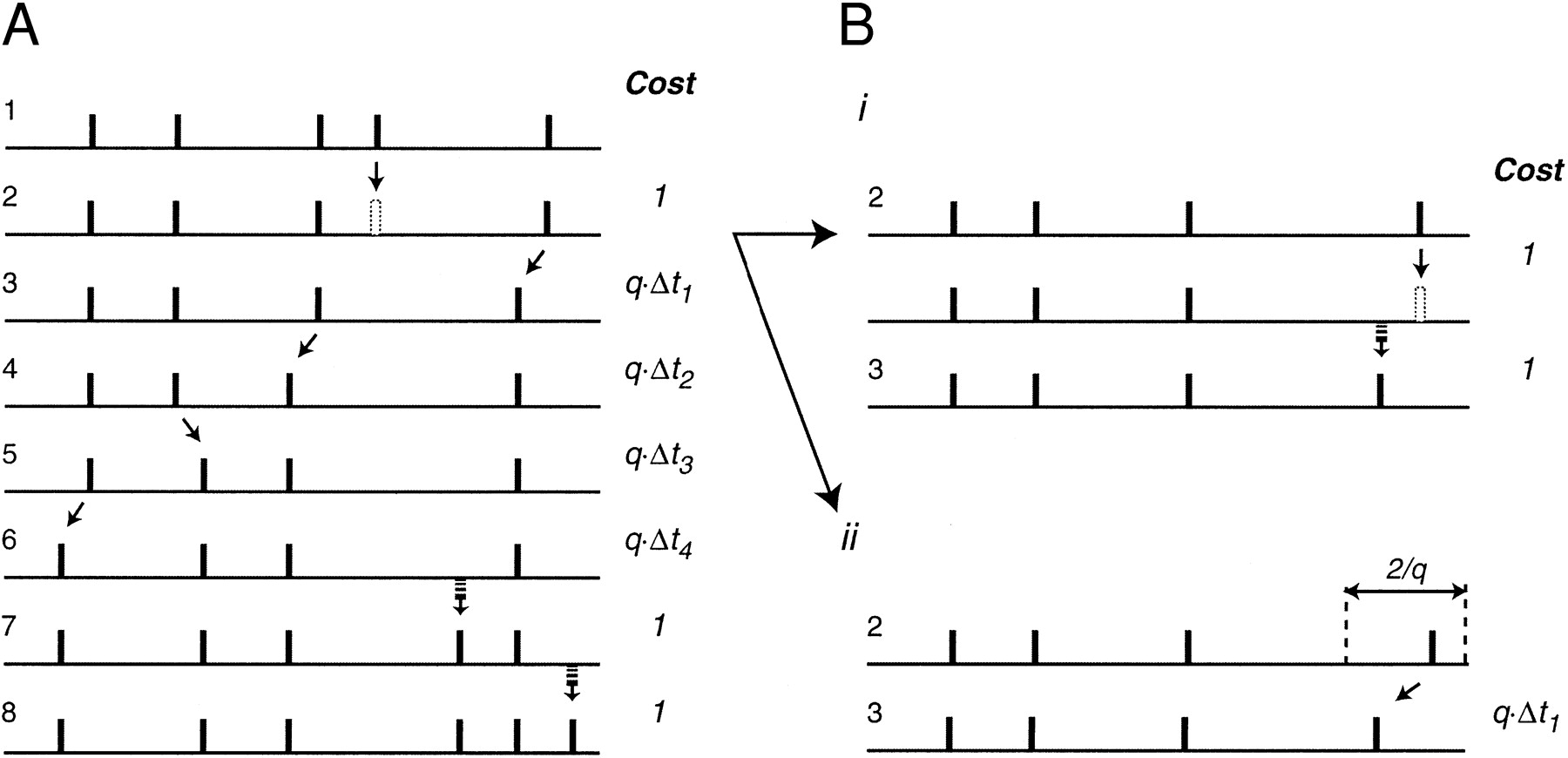
Computation of spike train distances. The distance between 2 spike trains was obtained as the minimum cost to convert one spike train into the 2nd one using 3 elementary steps. A: the minimum cost path transforming spike train 1 into spike train 8 is illustrated (for a fixed value of q). Each intermediate spike train 2–7 corresponds to one elementary step: moving (from 2 to 3), adding (from 6 to 7) or deleting (from 1 to 2) a single spike. The cost of each elementary step is indicated on the right. Note that the cost of moving a spike is proportional to the distance that it is moved along the time axis. B: there are 2 alternatives to go from spike train 2 to spike train 3 in A: i) delete the last spike and add a new one or ii) move the last spike to its new desired position. The latter alternative is less expensive for the particular value of q illustrated here since q z uDt1u , 2 (the dashed time interval of length 2/q corresponds to the maximum displacement for which it is less expensive to move a spike).
More information can be found in Prof. Victor's web page.
| Department of Ophthalmology | ![]() |
![]() |
| Program in Neurobiology | ||
| Children's Hospital Harvard Medical School | ||
| Center for Brain Science, Harvard University | ||
| Swartz Center for Theoretical Neuroscience |
![]() |
![]() |
![]() |
![]() |
![]() |
![]() |
![]() |
HOME . PUBLICATIONS . COURSES